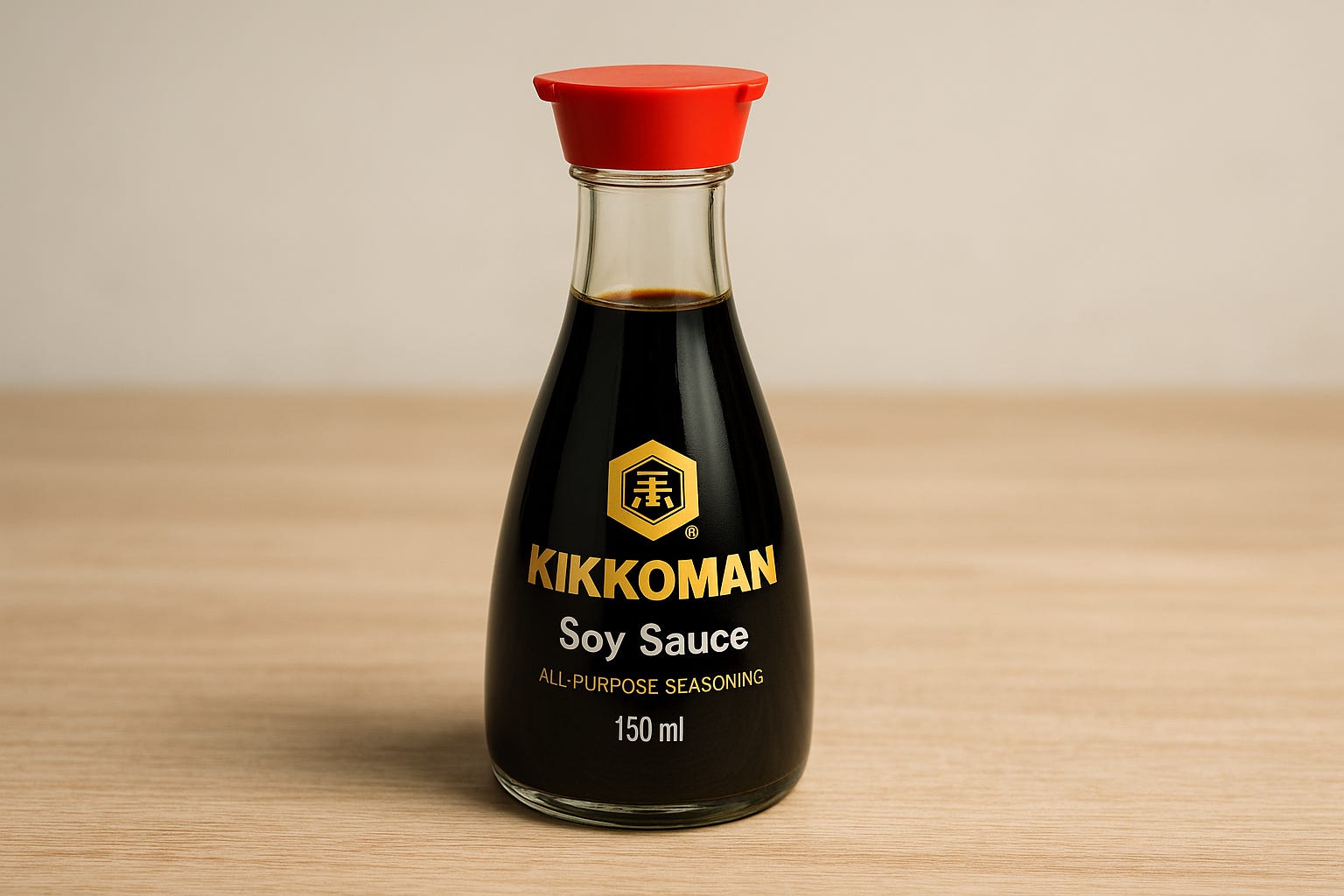
Shelf-Stable by Design: The Microbial Secrets of Soy Sauce Explained.

If you’ve ever wondered why soy sauce can sit in your pantry for months — even years — without refrigeration, you’re not alone. While most liquid condiments would spoil quickly if left unrefrigerated, soy sauce defies expectations. It is one of the few liquid foods that is microbiologically stable without preservatives or artificial processing.
But this isn’t magic. It’s science.
Water, Salt, and Microbes: The Perfect Balancing Act
At the heart of soy sauce’s resilience is its water activity, a key factor in food microbiology. Water activity (abbreviated as aw) tells us how much water in a product is actually available to support microbial life. While raw meat sits near a perfect 0.99 — basically an open invitation to bacteria — soy sauce typically measures around 0.75 to 0.85, depending on the brand and recipe. For comparison:
Raw beef: 0.99
Mayonnaise: 0.93–0.95
Soy Sauce: ~0.80
Honey: 0.60
Dried fish: 0.60–0.70
This low water activity is a direct result of high salt content (~16%) and fermentation-derived solids, which bind water and limit its biological availability. As a rule of thumb, most bacteria cannot grow below aw 0.90, and many fungi fail below aw 0.80 — making soy sauce an unwelcoming place for spoilage organisms.
Fermentation: Nature’s Biopreservation
Traditional soy sauce is fermented for months using Aspergillus oryzae, yeasts, and lactic acid bacteria. This process doesn’t just create umami; it also lowers the pH and introduces antimicrobial compounds like ethanol and organic acids. These natural by-products form additional barriers to spoilage — a principle known as hurdle technology.
In short: soy sauce is a perfect storm of microbial resistance. It’s acidic. It’s salty. It has low water activity. It’s fermented. And it doesn’t need refrigeration — although some manufacturers recommend it for flavor preservation over time.
The Broader Lesson
Soy sauce is a brilliant example of how traditional food processing techniques can achieve the holy grail of shelf-stability without sacrificing health or authenticity. In a world obsessed with “natural” and “clean label,” it serves as a blueprint for modern food product development.
Want to create shelf-stable sauces without artificial preservatives?
Start with an understanding of water activity, pH, salt, and fermentation.
Read the full technical article here:
👉 https://freshfoodnovelties.com/2025/07/19/why-soy-sauce-lasts-so-long-the-science-behind-its-shelf-stability/
ir. Wouter de Heij
Engineer | Food Tech Innovator | Founder of FreshFoodNovelties.com
For daily stories on breakthrough food technology and real-world product innovation.